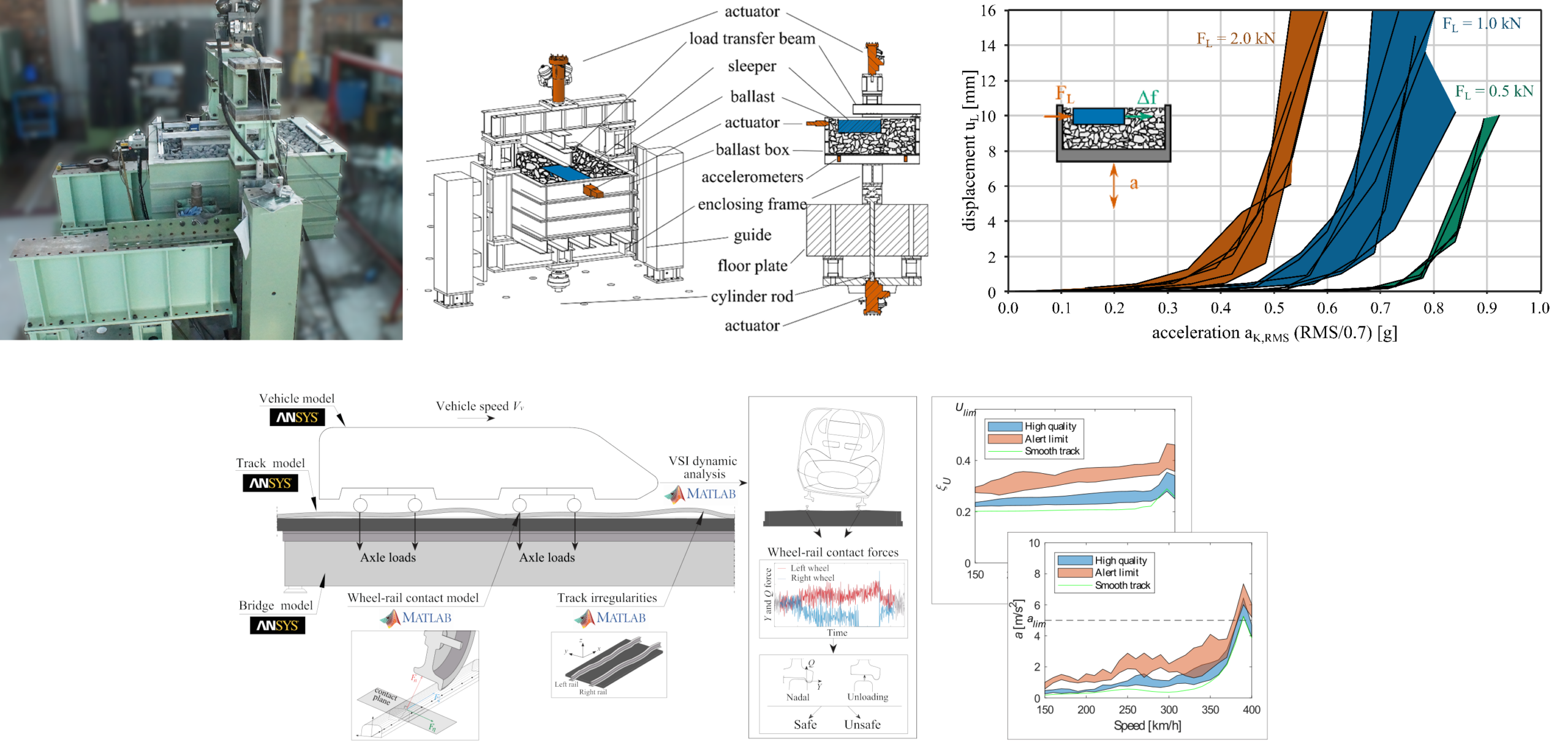
The InBridge4EU project has concluded Work Package 5 (WP5) with the release of Deliverable D5.2 “Revision of the acceleration limits in bridges with ballasted tracks”, published in November 2025. This marks a major step toward refining Eurocode provisions for dynamic assessment of railway bridges.
WP5 addressed the relevance of acceleration limits, given that excessive deck vibrations can compromise ballast stability, leading to settlement, lateral creep, and reduced track resistance, which are critical factors for safety and maintenance. To tackle these challenges, the consortium combined shake table experiments, full-scale bridge tests, and advanced numerical simulations, including Discrete Element Modelling and probabilistic safety analyses.
The research confirmed that lateral resistance decreases with increasing acceleration, even below the traditional 0.7 g threshold, and that high-frequency vibrations and single pulses cannot be ignored. Based on these findings, WP5 proposes a more risk-informed approach to assessing ballasted bridges, including scenario-based frameworks for lateral creep and a reassessment of the current safety factor of 2.0 in the EN 1990.
With WP5 completed, InBridge4EU advances toward harmonized, cost-effective standards for European railway infrastructure. The full deliverable can be found here.